Posts

Showing posts with the label POLICIES

Growing support for a green economic recovery after coronavirus pandemic

Image
Versión en Español Type of post: NEWS IN BRIEF. Governments worldwide are preparing their stimulus plans to counterbalance the economic “tsunami” caused by coronavirus pandemic. These economic incentives offer an excellent opportunity to build a just and sustainable economic system. Last weeks, many voices from different sectors and tiers are calling for a green recovery. The BioRefineries Blog joins this flow echoing two high-profile examples. Figure 1. Voices call for a green recovery after coronavirus pandemic (extracted from the document “ Green Recovery Call to Action and Signatories ”) Europe – Green recovery alliance One week ago, the “green recovery alliance” was launched at the initiative of Pascal Canfin, a French MEP who chairs the European Parliament’s committee on environment and public health. In addition to 79 MEPs, the alliance also brings together civil society groups, including 37 CEOs (Acciona, Danone, Ikea, H&M, Neste, Unilever…), 28 business...

BIC launches public consultation on the SIRA 2030 for a Circular Bio-based Europe

Image
Versión en Español Type of post: NEWS IN BRIEF. BIC invites all relevant stakeholders and society to contribute to the development of the Strategic Innovation and Research Agenda (SIRA 2030) for a Circular Bio-based Europe by participating in a public consultation. It will compile the results of this consultation on an anonymous basis in a report which will be published on its website. The EC is also reviewing the draft in parallel to the public consultation. Press release: Public consultation on SIRA 2030 , 25/3/2020. Link to the consultation: https://form.jotform.com/Biobased_Industries/SIRA2030-consultation (Deadline: 30th April). Draft SIRA 2030 . Figure 1. BIC launches public consultation on the SIRA 2030 for a Circular Bio-based Europe The emerging bio-based industries sector, coordinated by the Bio-based Industries Consortium (BIC), is cooperating with the European Commission to create a new public-private partnership under Horizon Europe. The objective ...

Germany launches its National Bioeconomy Strategy

Image
Versión en Español Type of post: NEWS. The Federal Cabinet of Germany adopted its National Bioeconomy Strategy yesterday. The new strategy sets the framework for the successful expansion of the bioeconomy in the next few years. A sustainable way of life and economy protects the climate and the environment while guarantees future prosperity. That is why Germany is focusing on boosting the bioeconomy. Press release: “ Nationale Bioökonomiestrategie für eine nachhaltige, kreislauforientierte und starke Wirtschaft ”, 15/1/2020. National Bioeconomy Strategy – Cabinet paper . National Bioeconomy Strategy – Summary . Figure 1. Cover of the National Bioeconomy Strategy of Germany In this way, the Federal Government bundles its previous activities in this field and sets the basis for further development. The Federal Ministry of Food and Agriculture (BMEL) and the Federal Ministry of Education and Research (BMBF) will be in charge of the activities. The strategic goal...

The Advanced Biofuels Coalition welcomes the European Green Deal

Image
Versión en Español Type of post: NEWS IN BRIEF. The Advanced Biofuels Coalition (Leaders of Sustainable Biofuels, LSB) has issued a communication welcoming the European Green Deal published on 11 th December and  stating that advanced biofuels are an important solution for reducing GHG emissions from transport. Communication: “ Green deal driving advanced biofuels from niche to norm ”, 11/12/2019. Video. Green Deal Proposal LSB is a coalition of leading advanced biofuels producers and technology providers committed to making a strong contribution to meet the EU ambitions of reducing transport emissions. It is working closely with the institutions and the Member States promoting the development and use of advanced biofuels in the European Union. Following Parliament’s recent declaration of a climate emergency, Commission President von der Leyen unveiled in the Brussels Chamber the plans to achieve climate neutrality in the EU by 2050. LSB supports the goal...

Renewable Fuels: Advancing European Market Uptake

Image
Type of post: ARTICLE. ADVANCEFUEL Project Author: Vanessa Vivian Wabitsch, REVOLVE Contributors: Ayla Uslu, ECN part of TNO, Thomas Christensen, Imperial College, Cosette Khawaja, Rainer Janssen, WIP Renewable Energies; Rita Clancy, Eurida Research. Discovering the world, working with people across the globe, commuting to work everyday or consuming exotic fruits imported to Europe – nearly every European is used to at least one of these habits producing a significant amount of carbon emissions. On the road to decarbonizing transport and reaching climate targets, the market uptake of renewable fuels is essential. The European transport sector is the only major sector where greenhouse gas (GHG) emissions are continuously increasing. In 2017, transport emissions (excluding international aviation and maritime) represented close to 22% of the total European emissions; and it is estimated that these carbon emissions have risen by 20% since 1990. While road transport has cont...

The Spanish Bioethanol Association is born

Image
Type of post: NEWS IN BRIEF. On June 25, the foundation ceremony of the Spanish Bioethanol Association took place. This association is born to promote the use of biofuels that substitute gasoline in the mobility sector. These are two of the first specific objectives of the association: - To promote an adequate training and information on this renewable fuel in such a way that its advantages are known by the administrations and the whole society. - To achieve that the final user can find the blend known as E85 (85% bioethanol, 15% gasoline) in the Spanish refuelling stations. Figure 1. E85 pump The press release issued states that: "Bioethanol is a renewable fuel produced from sustainable crops that provides undoubted environmental improvements, contributes to the development of the rural economy and the maintenance of jobs in the agricultural sector and is a transition towards a low carbon economy, without the need to put at risk the European automotive ...

BIC announces that efforts for setting SIRA 2030 have begun

Image
Type of post: NEWS IN BRIEF. The Strategic Innovation and Research Agenda (SIRA), first adopted in 2013 and updated in 2017, translates the ambitions of the (Bio-based Industries Consortium) BIC into a set of actions designed to deliver tangible and increasingly ambitious results by 2020 and by 2030. According to a recent announcement, the process of preparing the SIRA 2030 has already begun. BIC announcement: “ Taskforces for SIRA 2030 ”, Vision containing BIC ambitions: “ The circular bio-society in 2050 ”. Detailed list of the taskforces and the topics: “ Taskforces for 2030 SIRA ”, 5/2019. Related post: “ SIRA 2017 – Guidelines for the European biorefining sector of the future ”, 26/6/2017. Figure 1. Cover of the BIC document: “Taskforces for 2020 SIRA” In order to set the SIRA 2030, four taskforces have been created and categorised into four areas linked with the four key drivers identified in the industry's 2050 Vision. Taskforce 1: Integrat...

RoadToBio project publishes roadmap showing the path to an overall 25% share of biobased products in the European chemical industry

Image
Type of post: NEWS IN BRIEF. RoadToBio project has been funded by the Bio-Based Industries Joint Undertaking under the European Union's Horizon 2020 research and innovation programme from 1/5/2017 to 30/4/2019 to pave the way for the European chemical industry towards a higher biobased portfolio and competitive success based on the benefits offered by the bioeconomy. Its main goal was to create a roadmap for the chemical industry with the aspiration to increase the share of biobased or renewable feedstock to 25% of total volume of organic chemicals feedstock used in 2030. The 25% target was set by the Bio-based Industries Consortium (BIC) in the 2017 Strategic Innovation and Research Agenda (SIRA). The project was completed recently with the publication of the Roadmap . The way that this report has been prepared is designed to ensure it has credibility with industry, academic and other stakeholders and is recognised by governments as a useful contribution when consider...

Czech Republic, Poland and Slovakia sign a declaration to support decarbonisation of transport using locally produced clean biofuels

Type of post: NEWS IN BRIEF. The Ministers of Agriculture of the Czech Republic, Poland and Slovakia have signed a joint declaration on the Renewable Energy Directive post 2020 (12/4/2019) expressing their support for the initiative to reduce greenhouse gas emissions and increase renewable energy share in the transport mix, in which farmers are directly involved. Such statement clearly supports the decarbonisation of transport using locally produced clean biofuels that boost rural areas and farmers. The promotion of the use of biofuels produced under strict rules of sustainability from domestic sources is the pillar of the declaration. I quote literally some interesting insights of the statement: - We believe that the targets under RED II shall be achieved primarily by the local sourced production ensuring energy security and preservation of jobs and agricultural activities in the EU. - We highlight the necessity to reach a regional agreement on the crucial aspects ...

EERA Bioenergy Joint Programme launches its Strategic Research and Innovation Agenda

Image
Type of post: NEWS IN BRIEF. Researchers from 36 organizations in 18 countries, grouped within the framework of the Bioenergy Joint Program of the European Alliance for Energy Research (EERA), have published their Strategic Research and Innovation Agenda . As highlighted by a press release provided by the Technical Secretariat of EERA Bioenergy, this agenda defines priorities and perspectives by 2030, with the aim of joining the efforts in research, development and innovation in bioenergy of the different Member States and achieving the enormous potential of biomass-based solutions contribute substantially to the energy transition. Figure 1. Andrea Monti (Coordinator of EERA Bioenergy) with Adel El Gammal (Secretary General of EERA), from left to right. Courtesy of the  Technical Secretariat of EERA Bioenergy. The agenda evinces the consensus reached by researchers on how to deal with the challenges that decarbonisation policies address from a research and innovati...

Profile: ADVANCEFUEL project – Enabling a new generation of renewable transport fuels

Image
Type of post: PROJECT PROFILE. Driven by a maturing market and policy targets to reduce carbon emissions, the use of renewable fuels grew rapidly in the early 2000s. However, experts and consumers started to question the sustainability of conventional biofuels. Now, a new sustainable generation of renewable transport fuels is emerging, but numerous barriers remain. To enable the commercialisation of such fuels, the ADVANCEFUEL project is creating new knowledge, tools, standards and recommendations to overcome hurdles to their market roll-out. This Horizon 2020 project is developing a framework to monitor the status quo and outlook of liquid advanced biofuels produced from lignocellulosic feedstocks and liquid renewable alternative fuels produced from renewable hydrogen and CO 2 streams. The project is also examining the challenges of biomass availability, new and innovative conversion technologies and socio-economic and environmental sustainability across the value chain. ...

US Biomass Research and Development Board unveil implementation framework for advancing the bioeconomy

Image
Type of post: NEWS IN BRIEF. The US Biomass Research and Development (BR&D) Board (an interagency collaborative which is co-chaired by the Department of Agriculture and the Department of Energy) unveiled last week a strategy to accelerate innovative technologies that harness country’s biomass resources for biofuels, bioproducts and biopower. The guiding document “ Bioeconomy Initiative: Implementation Framework ” outlines an approach for implementing the strategy. Figure 1. Cover of the guiding document “Bioeconomy Initiative: Implementation Framework” The Framework will serve for the BR&D Board member agencies to increase government accountability and accelerate innovative and sustainable technologies that contribute to a secure, reliable, affordable and enduring supply of energy and products. It defines goals and actions for addressing knowledge and technology gaps in: - Advanced algae systems. - Feedstock genetic improvement, production, management and ...

A new Bioeconomy Strategy for facilitating the deployment of sustainable biorefineries across Europe

Image
Type of post: NEWS IN BRIEF. It is the news of the moment in the biorefining sector in Europe: the European Commission has just issued an update of its bioeconomy strategy. Launched and adopted on 13 February 2012, Europe's Bioeconomy Strategy addresses the production of renewable biological resources and their conversion into vital products and bioenergy. The 2018 update aims to accelerate the deployment of a sustainable European bioeconomy so as to maximise its contribution towards the 2030 Agenda and its Sustainable Development Goals (SDGs), as well as the Paris Agreement. Main stakeholders are welcoming it with excitement. Dirk Carrez, BIC Executive Director, said: “ Although progress has been made, further action and a stimulating policy framework is needed to leverage private investments. A continuation of a public-private partnership for the bioeconomy under Horizon Europe will be an additional driver, allowing implementation of the updated Bioeconomy Strategy in ...

RED II agreement - Target for 3.5% advanced biofuels for the EU by 2030

Image
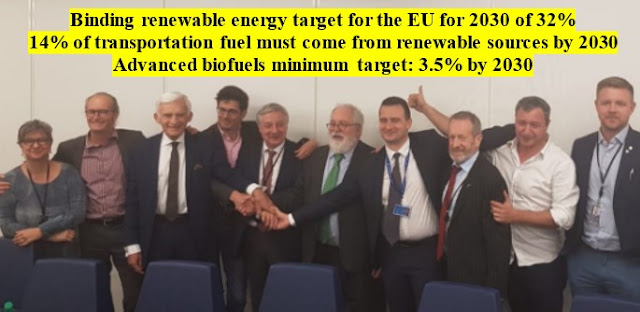
Type of post: NEWS IN BRIEF. On June 14, a political agreement on a revised Renewable Energy Directive (RED II) was reached between negotiators from the Commission, the European Parliament and the Council (see official statement , 14/6/2018). The new regulatory framework includes a binding renewable energy target for the EU for 2030 of 32% with an upwards revision clause by 2023. The press release does not mention the new rules affecting biofuels. However, several media have disclosed some key points of the agreement that I highligth below: - At least, 14% of transportation fuel must come from renewable sources by 2030 . - Crop-based biofuels are capped at 2020 levels but cannot exceed 7%. - Advanced biofuels with minimum targets : 0.2% in 2022, 1% in 2025 and 3.5% in 2030 . - Food crops (such as palm oil) that result in high indirect land use change (ILUC) are to be phased out through a certification process for low-ILUC biofuels. Figure 1. MEPs posing with Mig...